
Divan bed vs slatted base — a choice to which most people devote a few seconds when buying a bed, even though it determines how the whole next decade will be spent sleeping. After all, the base is the only part of the bed that no one sees once assembled. All the easier it is to forget about it.
The difference between a box spring and a slat base is hardly noticeable in the first few weeks. A new mattress forgives a multitude of sins. You will only notice it after a year, sometimes two — in how well the mattress holds its shape, whether a dip is forming in the middle, and how well the bed breathes. Let us go through both solutions objectively.
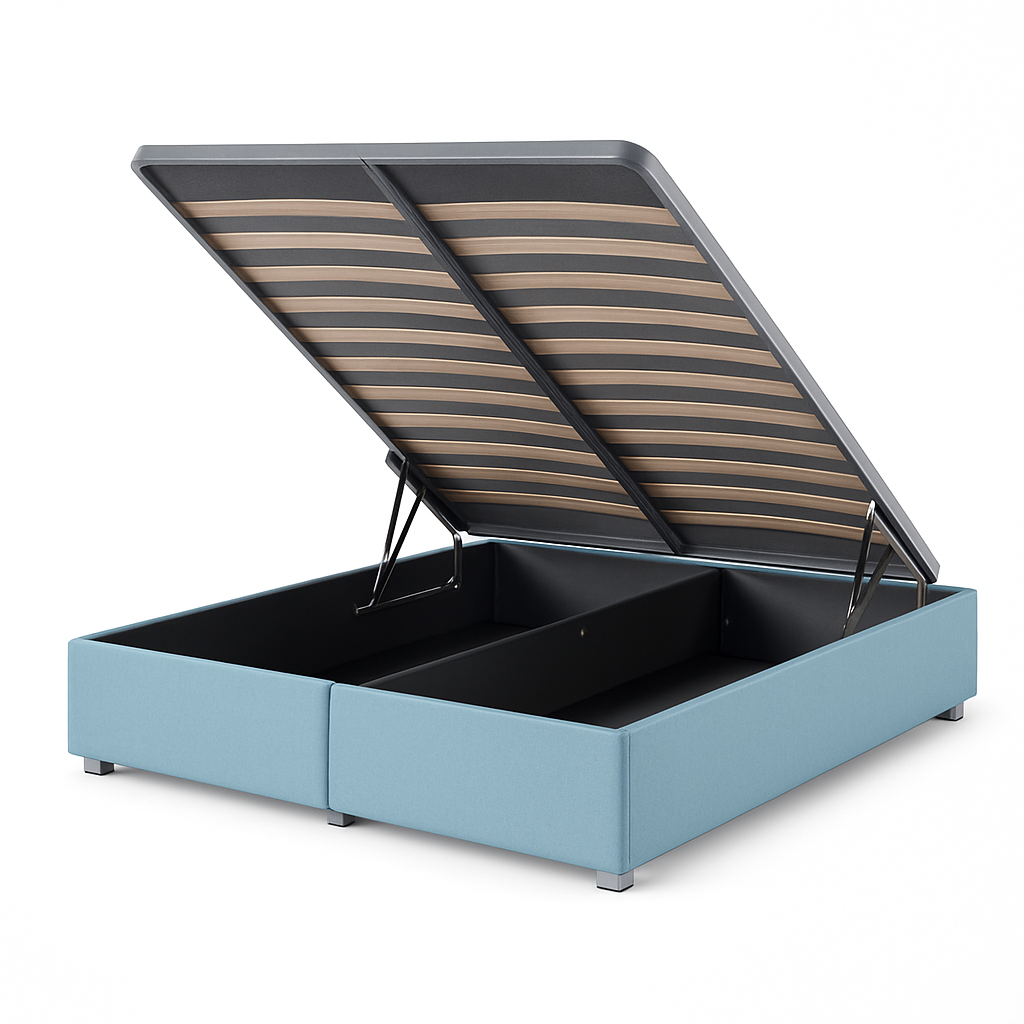
What is a sprung base and what is a slat bed base
Both constructions perform the same function — they support the mattress and transfer the load to the floor. However, the way they achieve this is different for each.
sprung base
A spring box is an upholstered box with its own spring system inside. It does not act as a passive base, but as a second layer of cushioning beneath the mattress. It distributes the load evenly across the surface rather than at individual points.
Practical consequence: the mattress on the spring box works evenly across its entire surface. It has nowhere to form a local indentation, because underneath it there is no point-like transition between support and empty space.
Slatted bed base: flexible wooden slats
The slatted base consists of flexible slats, usually made of laminated beech or birch wood, set within a frame. They provide support through flexion — each slat bends where the body exerts pressure on it.
The advantage is the air. It flows between the slats and the mattress is ventilated from below, which is essential for the removal of moisture that a person naturally gets rid of during the night.
Five differences that only show over time
- Load balancing. Springbox provides even support across the surface, whilst the slatted base offers targeted support through the slats. For heavier sleepers or couples with a significant difference in weight, the difference will become apparent sooner.
- Breathability. Slatted bed bases are in the lead, spring boxes are only catching up with them in the quality of the upholstery and covers. In a bedroom with higher humidity, it is worth considering.
- Total height of the bed. Springbox adds 25–35 cm, whilst the slatted base in the frame adds considerably less. This affects how easy it is to get out of bed.
- Sound and stability. Slats in a frame make noises over time, whereas a spring box as an enclosed structure remains silent.
- The lifespan of a mattress. Even support extends the time before the mattress loses its shape. It is precisely here that the difference accumulates the most slowly and is the hardest to reverse.
Comparison at a glance
| Criterion | Springbox | Slatted base |
|---|---|---|
| Load balancing | uniform, even | spot lighting through the slats |
| Breathability | depends on the upholstery | very good |
| Bed height | higher | lower |
| Adjustable stiffness | determined by the design | frequently adjustable |
| Noise levels after several years | minimal | possible creaking |
| Combination with a high mattress | ideal | suitable for a high-quality frame |
When to choose a springbox
Springbox makes sense wherever it’s used deep mattress with pocket springs. The two layers of springs, one on top of the other, work together — the mattress provides anatomical support, whilst the box spring absorbs and distributes pressure.
Consider it if:
- you want a bed at a height that makes it easy to get up
- you sleep as a couple and motion transfer would disturb you
- you are looking for a quiet construction with no sounds
- your mattress is over 24 cm
This is precisely the principle it is based on continental beds — layering the base, mattress and topper, where each layer does one job properly.
When is a slatted base better
The slatted base excels where room height is a factor or where maximum ventilation is needed. It is also worthwhile for adjustable beds where the head and foot sections are raised.
One condition always applies: the frame must be rigid and there must be plenty of slats. A sparse slatted base with large gaps can ruin even an excellent mattress within a single season.
And what about storage space?
The choice of base often hinges right here. The good news is that both approaches can be combined — an ottoman base with a slatted frame opens up the entire volume beneath the bed while retaining breathability.
A complete overview of variants, including boxes and chests, can be found in the category divans and bed bases.
How we approach it
We manufacture beds and mattresses in the Czech Republic and offer a five-year guarantee on both. We therefore do not treat the base as an accessory, but as part of a whole — the mattress, box and topper are designed together.
We manufacture to order, so non-standard dimensions are not an obstacle. The delivery time is between six and eight weeks.
Making a decision from a desk is harder at the base than with a mattress — the difference is felt, not seen. Come and try both out in our showroom on Vinohradská in Prague or in Hradec Králové. Our specialist Petr Žák can also advise you on 725 708 777, or alternatively write to zak@royalcomfort.cz.