
What bed and mattress weight capacity do you need when you weigh more than the average sleeper, or when two people with different body weights sleep on a single bed? Weight capacity is not just a number in a specification table. It determines how long the mattress will maintain its shape, whether the frame will start to squeak, and whether your spine will lie in a natural alignment during the night. In this article, we will go through what weight capacity actually means, which parts of the bed affect it, and what is worth focusing on when dealing with higher weight.
What bed and mattress load capacity means
Load capacity indicates the weight a bed can support over the long term without losing support or permanently deforming. However, for both the mattress and the bed, it needs to be interpreted a little differently.
- Mattress weight capacity is usually stated per person, that is, per single bed. An 180 × 200 cm mattress with a load capacity of 130 kg does not mean 130 kg in total, but rather support for each of the two sleepers.
- Bed weight capacity this applies to the whole structure – the frame, base, legs and headboard. The weight of the sleepers, mattress and topper is included in this calculation.
- Static vs. dynamic loading – a lying person loads the bed evenly. Sitting on the edge or sitting down abruptly creates a much higher point pressure for a short time. A high-quality design takes this into account with a margin of safety.
We recommend choosing a bed with a safety margin of at least 20–30 kg above your weight. The materials will then not operate at their limits and will last longer.
Bed weight capacity: frame, base and legs
A bed is only as sturdy as its weakest joint. For higher weights, therefore, pay close attention mainly to these parts:
- Base frame – the solid wood frame bears the load evenly and does not warp. Weaker chipboard frames will eventually start to sag at the joints.
- Number and arrangement of legs – with wider beds, central support is also important. The more support points there are, the less load falls on each of them.
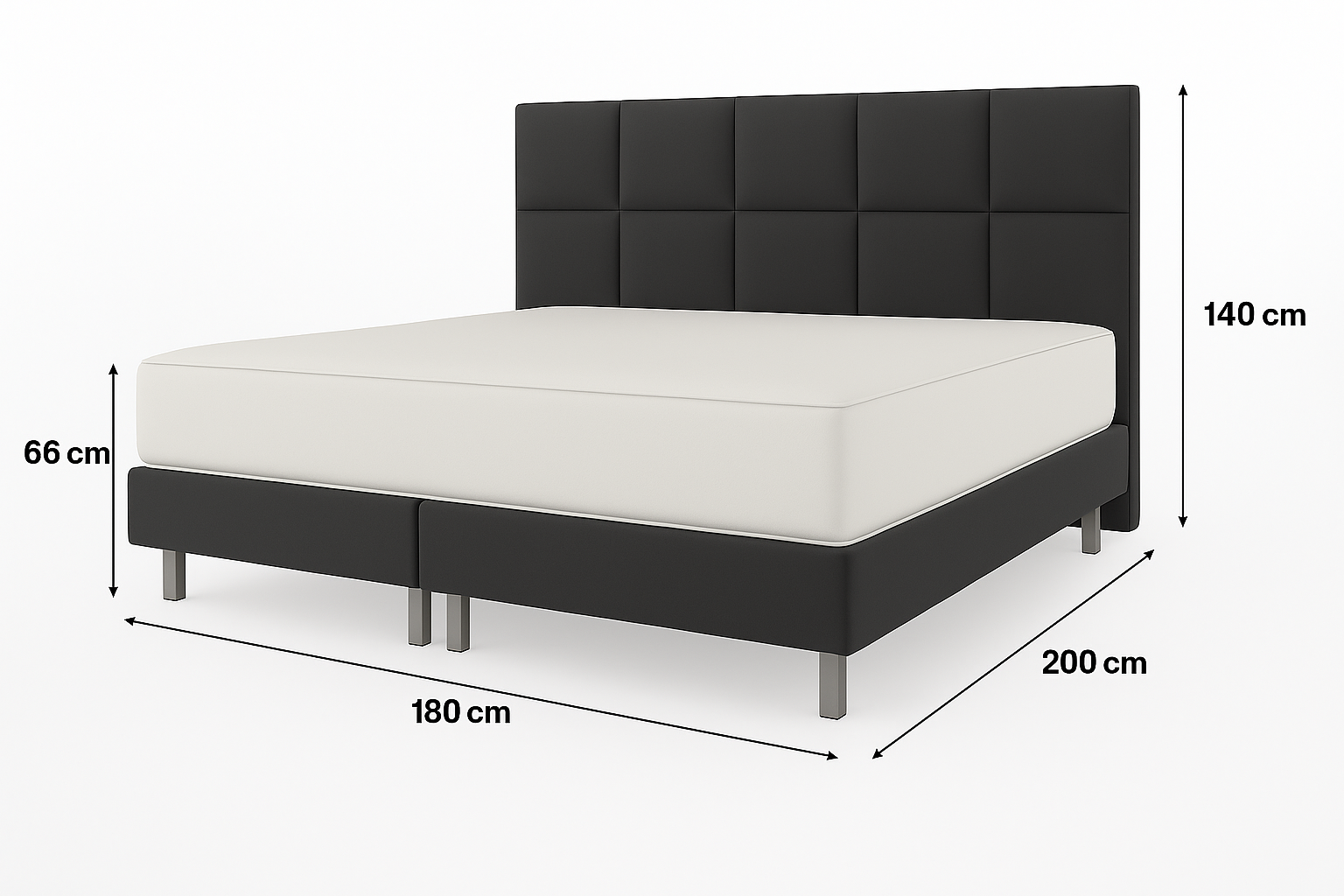
- Split base – from a width of 160 cm, the bed usually consists of two separate parts. Each supports only its own half and the bed is more stable.
- Face anchoring – you lean your forehead against it when reading or watching television. The sturdy attachment to the base prevents wobbling and creaking.
An overview of fixed-base models can be found in the category continental beds with spring box. If you already have a bed and are only sorting out the lower part, take a look at divans and bed bases.
Spring box, or a slatted base for higher weight?
A slatted base bears the load on individual slats. With higher weight, the slats sag or crack over time and the mattress above them loses even support. A spring box – the sprung base of a continental bed – distributes the weight across the entire surface and springs together with the mattress. Both layers thus share the load and neither is overloaded. A detailed comparison can be found in the article Box spring or slatted frame?
Mattress weight capacity: what determines it inside
The load capacity of a mattress is not determined by a single parameter, but by a combination of the core, foams and side construction.
- Pocket springs – each spring is in a separate pocket and reacts independently. It depends on the wire thickness and spring density; a thicker wire means firmer support.
- Zone system – A 5-zone or 7-zone spring system firms up the pelvic area, where the load is greatest, and relieves pressure on the shoulders.
- Foam case with reinforced side panel – holds its edge shape, so the mattress doesn't sag when sitting on the edge.
- Foam density – Performance foam or higher-density latex fatigues more slowly and maintains its original height for longer.
- Mattress height – deep mattresses from 24 cm They have more room for the support layers and a comfortable top section. The body won't press through to the firm core.
Which firmness of mattress to choose for higher weight
Firmness and weight capacity are related, but they are not the same thing. Firmness determines how deep you sink into the mattress; weight capacity, how long the mattress will last. A rough guide:
| Weight of the sleeper | Recommended hardness | Model examples |
|---|---|---|
| do 70 kg | soft to medium-firm | Dreamify Soft, Imperial Suite Soft |
| 70–100 kg | medium firm | Royal I., Royal II., Majesty Premium |
| 100–130 kg | hard | Diamond, Imperial Suite, Dreamify Hard |
| over 130 kg | hard to ultra-hard, upon consultation | Switzerland Original, Dreamify ULTRA HARD |
The table is a guide, not a rule. Sleeping position and body shape also play a role. You can narrow down your selection in the category firm mattresses, we cover the topic in more detail in the article What mattress firmness according to weight.

Do you sleep as a couple with different weights?
When partners differ in weight by 30 kg or more, a single shared mattress usually does not suit them both. The lighter sleeper rolls into the depression created by the heavier partner, and both wake up more often during the night.
The solution is simple: two separate mattresses with different firmnesses on a split spring box. Each half of the bed then suits the person sleeping on it. The transition between the mattresses is unified full-width mattress topper, so the joint cannot be felt. This combination is offered, for example, by POSTEL MAGNUM Online Edition, which can be assembled from two divan bases according to the bed width.
What to look out for when choosing a bed and mattress for a higher weight
Before you decide, go through this short checklist:
- Is the mattress weight capacity specified per person, and do you have a 20–30 kg margin on top of that?
- Does the base have a sturdy frame and enough legs, including a central support?
- Is a bed with a width of 160 cm or more divided into two parts?
- Does the mattress have reinforced sides and a zoned spring system?
- Is the mattress at least 24 cm high?
- Have you also taken into account your partner's weight and the position you sleep in?
Even a quality bed will wear out faster over time if it is working at the limit of its weight capacity. We summarise the signs that a mattress is losing its support in the article How often to replace a mattress.
Test out the load capacity for yourself
The specifications on paper tell you a lot, but fifteen minutes of lying down tells you the most. In our showrooms at Vinohradská 37/13 in Prague and in Hradec Králové, you can try out various combinations of spring boxes, mattresses and toppers, and compare how they react to your weight. We manufacture continental beds in the Czech Republic and we provide a 5-year warranty on our beds.
If you are unsure which combination to choose, our advisor Petr Žák will be happy to help – call 725 708 777 or write to zak@royalcomfort.cz. You can also find further tips on the page consultancy.