
How much space does a continental bed actually take up? The dimensions of a continental bed differ from a traditional bed frame with a slatted base, and that is precisely where most unpleasant surprises arise during a house move.
When choosing a bed, you usually remember a single number — 160, 180 or 200. However, the dimensions of a continental bed are calculated differently. The stated width refers to the sleeping area, meaning the mattress you sleep on. The outer outline of the bed is always somewhat larger because it includes the upholstered sides of the spring box. Added to this are the length of the headboard and the height, which, with high mattresses, plays a role both when getting into bed every day and when choosing a fitted sheet.
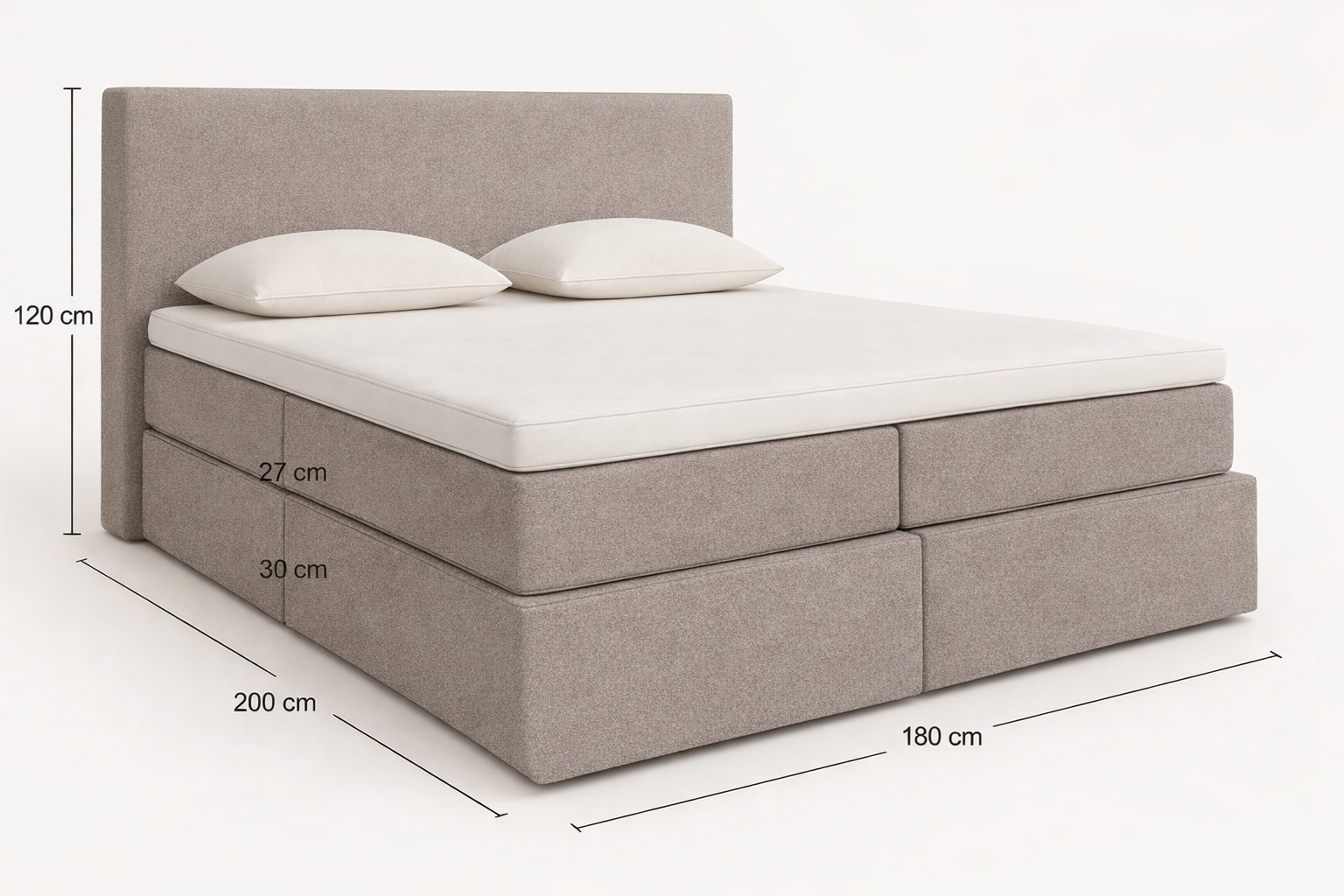
What do the dimensions of a continental bed consist of
A continental bed is a layered construction, not a single piece of furniture. Each layer adds its own millimetres and they all add up to the final figure that you have to get through the door.
From bottom to top, it is a box spring, or upholstered sprung base, on which lies a deep pocket-sprung mattress, and the whole thing is topped with a topper. The headboard is a separate piece that is either mounted to the bed or anchored to the wall — and the overall length of the assembly varies accordingly.
- Width — the stated dimension is the mattress width. The outer width is usually 8–12 cm greater depending on the thickness of the side upholstery.
- Length — the standard is a 200 cm mattress. With the headboard, allow for a total length of approximately 215–220 cm.
- Bed height — for continental beds it ranges between 60 and 70 cm including the topper.
- Height of the forehead — usually between 110 and 140 cm from the floor; even more for taller models.
Overview of widths from 90 to 200 cm
The following table shows how the bed width translates into actual space in the bedroom. Please take the external width values as an approximate range — for custom-made products, the exact figure depends on the chosen type of upholstery.
| Bed width | External width (approximate) | Recommended room width | For whom |
|---|---|---|---|
| 90 × 200 cm | 98–102 cm | from 230 cm | One person sleeping, guest room, young adults |
| 120 × 200 cm | 128–132 cm | from 260 cm | A rather demanding sleeper who needs space |
| 140 × 200 cm | 148–152 cm | from 280 cm | A set for a smaller bedroom – a compromise option |
| 160 × 200 cm | 168–172 cm | from 300 cm | The most common choice for couples |
| 180 × 200 cm | 188–192 cm | from 320 cm | A couple who each want their own space |
| 200 × 200 cm | 208–212 cm | from 340 cm | Large bedrooms, tall sleepers, families with children |
Most couples settle on a height between 160 and 180 cm. A difference of twenty centimetres may seem insignificant on paper, but in practice it means an extra ten centimetres for each of you — and that’s precisely the threshold beyond which you’ll stop waking each other up when you turn over. If the room allows it, it’s worth considering going for a taller bed.
How much space should you leave around the bed?
The size of the bed alone is not enough. It must still be possible to walk through the bedroom even when the wardrobe doors are open.
We recommend allowing for a margin at least 70 cm on either side, which you walk along. This is the width that allows you to walk past comfortably whilst also kneeling by the bed when making it. If there is a wardrobe with hinged doors in the bedroom, add the depth of the open door — usually a further 55 to 60 cm.
Minimum clear width
The absolute minimum is 55 cm. Below this limit, you have to squeeze sideways to get round the bed, and making the bed every day becomes an awkward balancing act. This is doubly true for a continental bed — a higher bed requires more space to move around than a low frame.
No gap is needed on the wall side; the bed can be pushed right up against it. But don't forget the bedside table: the standard depth is 35 to 45 cm, and in a narrow bedroom, it's precisely this piece that often doesn't fit.
Height: the dimension most frequently forgotten
Whilst everyone measures width and length, height is overlooked — until the moment you first sit on the bed.
The continental bed reaches 60 to 70 cm, which is roughly the height of a chair. You lie down by sitting on it and swinging your legs round, rather than lowering yourself towards the floor. For sleepers with sensitive knees, hips or backs, this makes a substantial difference to daily comfort — the correct bed height helps to ease strain when getting up.
Height also has a practical consequence. A standard fitted sheet is designed for mattresses up to 20 cm thick and simply won't fit a combination of a deep mattress and a topper. You need fitted sheet designed for deep mattresses with a deeper pocket.
How to measure your bed at home
Before choosing a specific model, go through these five steps. It takes a quarter of an hour and will save you complications on the day of delivery.
- Measure the bedroom at floor level and at a height of 70 cm. Sloping walls, windowsills and radiators often narrow the space precisely where the bed is going to stand.
- Mark out the outline of the bed with tape on the floor. Use the outer dimension, not the mattress width. You will see immediately how much space is left for walking.
- Check the route to the bedroom. The width of the door, the lift, the turn on the staircase. A continental bed is delivered in parts, but the spring box is a solid piece.
- Check the wall behind the bed. Switches and sockets at a height of 100 to 130 cm may collide with the headboard.
- Add the bedside tables. Add twice 40 cm to the external width and compare it with the width of the room.
When the standard size doesn't fit
Not every bedroom is a regular rectangle. Attics, apartments in historic buildings and segmented layouts often call for a dimension that is not in the catalogue.
We manufacture continental beds to order in the Czech Republic, so both the width and length can be adjusted. We most frequently deal with extended lengths of 210 or 220 cm for taller sleepers and non-standard widths between catalogue sizes. You can find the step-by-step guide from choosing the spring box to the headboard in the instructions how to choose and assemble a continental bed. The complete overview of models and available sizes is in the category continental beds.
One-sentence summary
Add ten centimetres to the stated width for the upholstery, twenty to the length for the headboard, leave seventy on the sides for walking space — and you have the realistic dimensions of the divan bed with which you can plan the bedroom.
If you are not sure whether the chosen size will fit in your bedroom, come and try out the beds in our showroom at Vinohradská 37 in Prague or in Hradec Králové. We will be happy to go through the floor plan with you and recommend the option that will suit you best. You can also contact our advisor Petr Žák directly at 725 708 777 or zak@royalcomfort.cz.