
How is mattress firmness determined by weight and why is weight the most reliable guide when choosing? In a clear table, you will find recommendations ranging from SOFT to ULTRA HARD.
The firmness of a mattress according to weight is the first figure from which everything else follows. The exact same mattress behaves completely differently under a person weighing 55 kilograms compared to someone weighing 110. What one person perceives as pleasantly firm support, another finds hard as a board — and vice versa. Therefore, when making a choice, we do not start with the question „do you want a soft or a firm one?“, but rather with how much you weigh and how you sleep.
Why mass matters more than first impressions
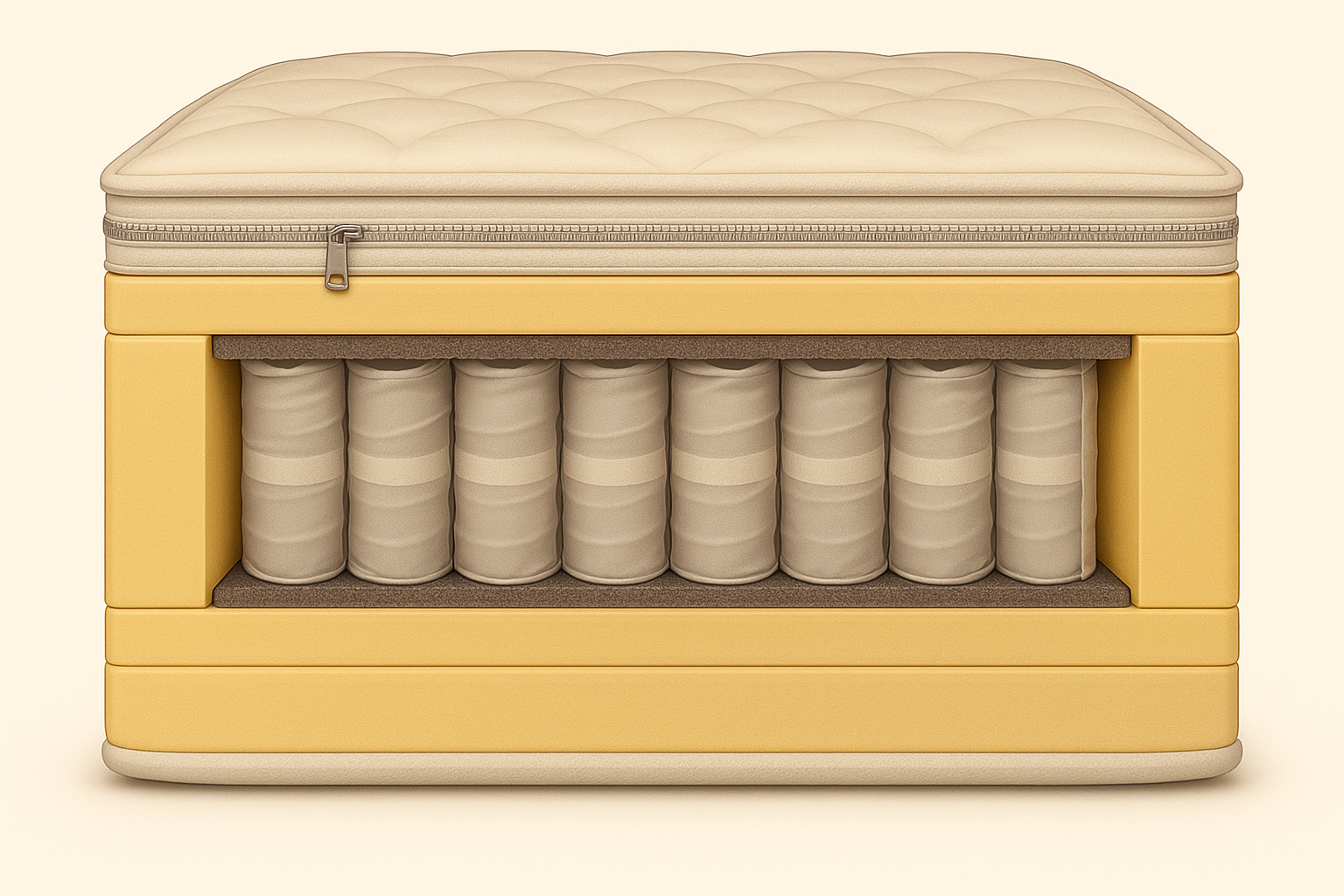
The mattress acts as a spring system designed to keep the spine in its natural alignment. When you lie down, your body presses into the mattress — and the depth of that sinking depends on the force you exert on the material.
A lighter person simply won't sink into a firm mattress. Their shoulders and hips will stay on the surface, the lumbar region will hang in empty space, and tension will build up there overnight. A heavier person has the opposite problem: on a mattress that is too soft, they will sink into the shape of a hammock and their spine will sag downwards. Proper spinal support helps to relieve tension in the back and shoulders — and that is precisely what the choice of firmness relates to.
A quick test in the shop won’t reveal this. When you lie down for two minutes, you mainly notice the comfortable outer layer, not how the construction will hold up after six hours. That’s why we recommend starting with the figures and only then fine-tuning based on how it feels.
Mattress firmness by weight: a clear guide
The table applies to one sleeping person and for deep mattresses over 24 cm, where the load-bearing layer is thick enough to compensate for the differences in weight at all.
| Weight | Recommended hardness | Typical models | What to watch out for |
|---|---|---|---|
| up to 60 kg | SOFT (soft) | Dreamify Soft, Imperial Suite Soft | A firmer mattress won’t sag in the middle |
| 60–80 kg | SOFT to MEDIUM | Royal I., Dreamify Medium | It depends on your sleeping position — it’s a bit softer if you sleep on your side |
| 80–100 kg | MEDIUM (medium-hard) | Royal II, Luxury, Comfy, Majesty Premium | The broadest category, suitable for most adults |
| 100–120 kg | HARD (hard) | Diamond, Imperial Suite, Dreamify Hard | Monitor the side reinforcement too, as people tend to sit on the edge |
| over 120 kg | ULTRA HARD | Switzerland Original, Dreamify ULTRA HARD | Check the load capacity of the specific model |
The boundaries between the categories aren’t clear-cut. If you’re on the cusp — say, 82 kg — it’s worth trying both neighbouring options. In the category medium-firm mattresses You’ll find the most models there precisely because it encompasses the largest section of the population.
Weight isn't everything: sleeping position and body shape
Weight determines the initial category; body shape and sleeping position shift it up or down by half a degree.
- Sleeping on your side — Your shoulders and hips need room to move. Choose a size one size softer than the one your weight would suggest.
- Sleeping on your back — the most balanced position. Follow the recommendations in the table.
- Sleeping on your stomach — The mattress must not sag. Choose a firmer mattress.
- Broad shoulders, narrower waist — A zoned support system will be more helpful than simply changing the overall firmness. Look for a 5-zone or 7-zone support system.
- Athletes and people with a higher proportion of muscle mass — for the same height, they weigh more than average, but distribute the load more evenly. The lower limit of the recommended category is usually suitable for them.
When you sleep as a couple and your weights differ
A difference of up to roughly 20 kilograms can be accommodated by a high-quality pocket sprung mattress — the springs work independently and each side reacts to its sleeper. For a greater difference, we recommend two separate mattresses side by side, each with a different firmness, joined by a single topper across the entire width. It smooths out the transition between them and the bed feels like a single unit.
How do you know if you have the hardness wrong
The body gives feedback relatively quickly. Pay attention mainly to the first hour after waking up:
- The mattress is too soft, if you wake up in the morning with tension in your lower back, toss and turn often during the night, and feel like you have to drag yourself out of bed when getting up.
- The mattress is too firm, if you feel pressure in your shoulder and side, your arms tingle at night and you can't find a position in which you could last longer than a few minutes.
- The firmness is spot on, when you wake up and can’t remember how you were lying during the night. That’s the right sign.
Before writing off the mattress, give it three to four weeks. A body used to a sagging old bed needs time to get used to the proper support — and the first few nights on a new mattress are therefore often misleading.
How does the design affect hardness?
Two models with the same hardness rating may behave differently, as they achieve the same result by different means.
| Structural element | How does it affect perceived hardness? |
|---|---|
| Pocket springs | They bear the main load. A higher number of springs per square metre means a more precise fit to the body. |
| Zonal system (5 or 7 zones) | It softens the shoulder area and firms the lower back. The firmness varies according to the part of the body. |
| Performance foam / latex | It determines the initial sensation when you lie down. Latex returns energy more quickly, whilst memory foam reacts more slowly. |
| Foam case with reinforced side panel | It retains its shape at the edges. This is essential if you sit on the edge of the bed. |
| Upholstery (Modena, Purotex, Royal Silver) | It has a minimal effect on hardness, but it does alter the feel of the surface and the microclimate. |
That is why simply reading the label is not enough when comparing products. In the categories soft i firm mattresses For each model, we specify the core composition so that you can see what makes up the particular hardness rating.
A topper for that final touch
If your mattress is half a degree off, there’s no need to replace the whole bed. A topper between 5 and 10 cm thick can soften the surface without compromising the support provided by the core. It has only limited effectiveness in the opposite direction — it won’t turn a soft mattress into a firm one. A topper also protects the top layer of the mattress and is easier to wash, which extends the lifespan of the entire set.
Give it a go and take your time
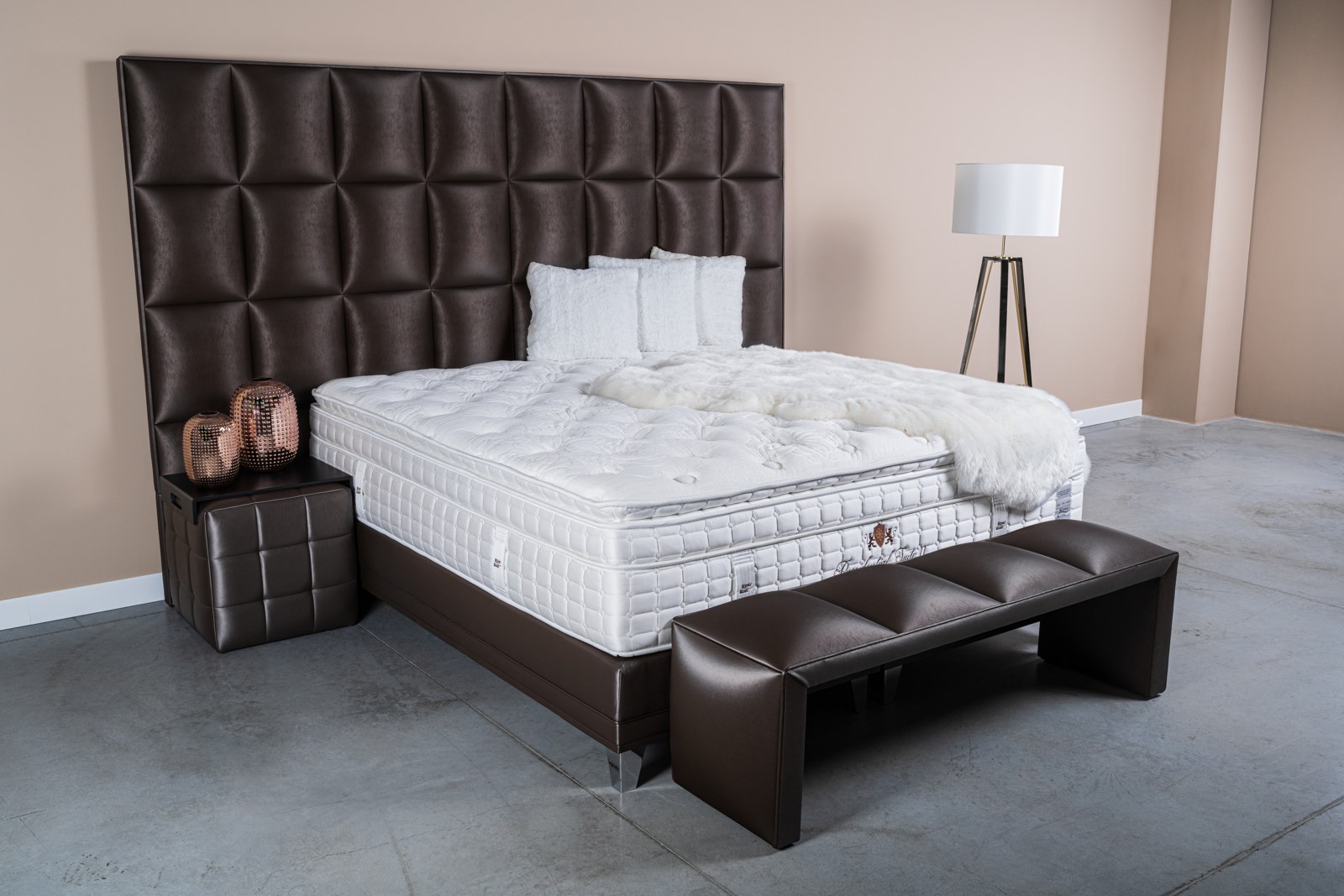
The table will guide you to the right category, but the final decision is up to your body. At our showrooms at Vinohradská 37/13 in Prague and in Hradec Králové, you can try out the mattresses side by side at your leisure — not just for two minutes, but for as long as you need. Bring your own pillow with you; it will give you a good idea.
If you’re not sure which mattress firmness level is right for you based on your weight, please contact our advisor, Petr Žák, at 725 708 777 or on zak@royalcomfort.cz. They’ll go through your weight, sleeping position and what you don’t like about your current mattress with you — and recommend specific models. We’d also be happy to advise you via our advice page.